
Or “Being Stubborn” is what call this in my head, and here’s why.
I took the photo below in July 2017 while strolling along in Carmel, California. Looking back, this was a hard one for several reasons. I attempted this atleast 20 times. While most of them ended up in the recycle bin, my daughter saved a few incomplete or failed attempts to put in her room.
Let’s start with the photo. The photograph is very pretty by itself but it has several issues when it comes to painting it.

- The composition does not have any interesting play of angles and shadows as all the elements are equally lit.
- The photo does not follow the 1/3-2/3 horizon.
- There’s no single focal point. There is too much going on and all bunches are competing for attention.
Why paint?
Like I said before, the photo is pretty by itself, so why paint it? Here’s what I had in mind.
- Capture all the drama of the petals and fern without being photorealistic.
- Experiment with loose, positive and negative painting style where some details are captured and some are left to imagination. (Impressionist style, but in watercolor)
- Watercolor has a mind of its own, so allow it do its magic and go with the flow.
Why in watercolor and dealing with the unpredictability that comes with it?
- Doing this in acrylic or oil would be easier because they naturally lend to Impressionist style. But I felt that the translucency of the watercolor were well suited for the colors.
- Speaking of colors, the petal shades are very close to each other with very subtle warm and cool undertones. Therefore several attempts ended in the bin because even a slight error in the values became irrecoverable. One can paint over acrylic or oil, but not easy in case of watercolor.
- Painting the fern leaves while giving an impression of depth. Here’s where I used negative painting where I am coloring outside the lines to make a blob of green look like a leaf.
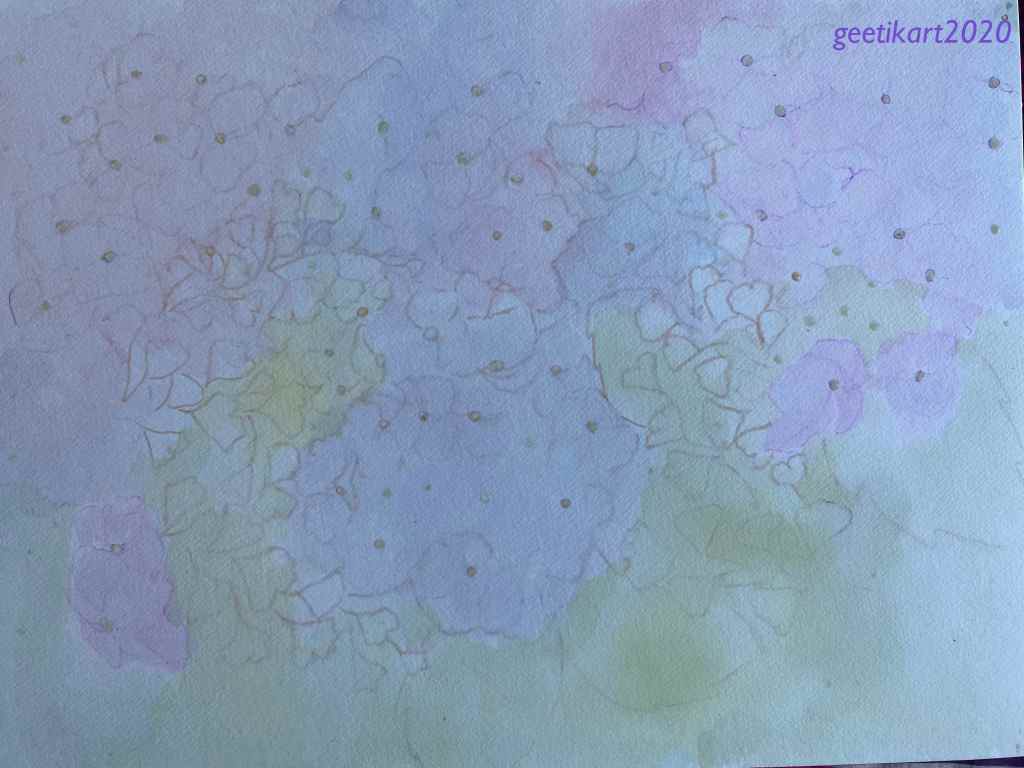
Here’s a few images on how I went about it. You will see that I did not sketch all the details instead just did some anchor points.

Next I used light washes to get the big shapes. Then gradually I worked on small sections. I took several breaks because it helped me avoid overdoing. While the photo was my desktop wall paper, I avoided looking at it while painting or looked at it with a blurry filter so I don’t get sucked into photorealism.
The urge to be capture every detail as a way to measure craftsmanship is high. I saw how hard it is to break old habits. As a stubborn watercolorist, I kept going at it until I was personally satisfied with the outcome.
 Artistory - Art that tells a story